
HR Focus in Start-ups to Succeed

Start-up companies can come in all forms and sizes. They seem to have high failure rates, but the minority who succeed can become large and influential.

It has been seen that most start-up founders more often have a casual or off-beat culture in their thinking, dress, office space, HR practices and Marketing, as compared to traditional corporations. Some of these casual approaches, such as the use of “flat” organizational structure, in which employees can directly communicate with the Founders or CEOs informally, are practiced to promote efficiency and to enthuse employees in the workplace.

Business Strategies for Finance, Marketing, Production, Product Development and Innovation are made without a robust HR and People strategy. The importance of this needs to be highlighted as this is one pillars of the foundation on which the businesses is built, and if this pillar is weak or not there the dangers will always loom. Having a HR and People plan is like a having Finance plan which is absolutely essential to a success of a start-up. If people are not the key focus area the start-up cannot succeed. The HRand People plan needs to be budgeted in the initial phase itself.

Hiring the right person is one of the biggest challenges for the start-up – it is not that getting people is a problem but getting the right-fit certainly is for most start-up organizations. Many a times compromises are likely to be made to get the organization moving quickly hoping that the incumbents will learn and adapt as we go along – something which a start-up needs to be careful about in my opinion.

All start-ups need people who are innovative, adaptable and flexible, analytical, emotionally intelligent, team players and have willingness to learn. They should be willing multi-taskers. Easily said than done – how do we find this out in an interview of an hour or two at the most?  The founder’s or CEO’s experience or gut-feel may not be sufficient to make those judgements. There is a professional way of doing thisby putting the person through professional Competency Assessment or Personality (Psychological) Tests.

As the organization matures and grows retention of good people becomes the challenge.Attracting,developing and retaining an amazing team are the hallmarks of success for any start-ups success. If there are right people they will design and redesign success strategies and fight for the organization’s success.

What HR policies should be there? How shouldthe elements of legality, predictability, fairness, equity and control be built into them require in-depth thought and insight as does the business plan. What has succeeded in one organization may not in another as each organization have a unique character and personality. Having policies is not good enough it is their proper implementation which is the tougher part and leads to dissatisfaction in most organizations over a period of time.

Just like business strategies and plans change the HR policies need to be revised and re-engineered keeping in view the business needs.

Making sure that the there is adequate focus on people besides other areas is most important in my opinion.

More Visit :- http://www.cengrow.com/

Employee Satisfaction Survey

Making Performance Management Work effectively

Managing Performance and keeping the workforce motivated is becoming increasingly complex and difficult particularly for the young brigade who is far more mobile and impulsive.
No system is perfect and permanent in any organisation. We need to continuously improve and adapt our processes to the changing environment.
Most organizations do have some form of Performance Management System as in recent times even Performance Appraisal is called the same. Firstly, let me clarify that Performance Appraisal is only one of the elements of the Performance Management System.
A robust Performance Management System (PMS) has 4 distinct sub-processes:
1. Formal Target Setting Process cascading down from the Annual Business Plan. It encompasses a participatory approach and is an open, transparent,data-based and an alignedprocess wherein the organization seeks to set challenging but realistic targets for all its employees.
2. Monitoring and Control involves an institutionalised and an on-going process for giving feedback, coaching and counselling to keepthe performance on track. This is the most important part of PMS and the organization needs to build the competence of its employees – it requires specialized training. This has invariably been a weakness in most organizations we have worked for in the last 30 years
3. The Performance Appraisal against the targets set in step 1 and any revisions thereafter. This requires the elements of subjectivity to be reduced and objectivity brought in. For this the appraisal form needs to be well designed. Self-appraisal often helps to bring acceptance and reasoning in the whole process. Appraiser and Reviewer both need to be data-based and objective to keep personal biases out.
4. A clearly defined Reward and Recognition Policy linked with thePerformance Appraisal contributes to building a motivated work-force. This needs constant review and updating year on year.
It is desirable to have the whole process fully documented with timelines with responsibilities clearly demarcated.
Other process such as Career and Succession Planning need to be in place for Performance Management to be more effective. Some Organizations do keep the two processes independent. However, the retention of talent has thrown a big challenge to many organizations as they grapple with balancing these processes.
More Visit :- http://www.cengrow.com/
What is a Sales Aptitude Test?

Sales Aptitude Test(SAT) are conducted to measure the personality traits that are grave to success in sales and similar related fields, primarily for the customer service, marketing, public relations and management and also, it assesses those traits also that aren’t apparent in an interview or resume. SAT is also known as customer service test, which measures the personality traits. It’s a boon for those who have the high level of patience, perseverance, cooperativeness and personal diplomacy and are kept on priority for customer service roles. Personality tests are conducted to select salespeople, because, according to the research conducted, to be a successful sales manager, you need to have certain personality traits. As a seller, you need to be more outgoing, aggressive, confident and of course, highly motivated.

Aptitude Test

Sales achievement predator or sales AP was introduced by Dr.Sander I. Marcus, Dr. Jotham G. Friedland, and Dr. Harvey P. Mandel. Sales AP helps the companies to groom salespeople. These people prepared a written test which contains 140 items and is written at a sixth-grade reading level. This scale contributes to adjust the score of those applicants who are at their extremes- either exceptionally brilliant or below average.

Cengrows is here to guide you and solve your queries about the salesmanship and help you to climb a step higher than yours. These days, personality tests contribute to select salespeople because many pieces of research have proved that certain personality traits are required to be successful in sales. According to the Sales Competency Assessment, aggressive people are quite competitive and highly motivated. Many times, low or negative correlations have been in highlight cooperation and patience because, to handle sales, you need to have both- patience and collaboration, which further leads to Sales skills assessment. The more accurate your Test score here, apparently, so will be your job performance.

In fact, various case studies have been conducted with the customers who state that the most successful salesperson is assertive, competitive, and impatient too- which is just the opposite of customer service personal.

The utmost thing to be taken care of or noted is that sales role varies from one organization to another; hence it will be an injustice to judge it as a larger picture. On the contrary, the basic building blocks remain consistent throughout the industry. You have to mold yourself according to your job profile and the requirement. Once you are in the seat, you are the boss who has to act accordingly.


How to Use Psychometric Testing in Hiring

According to a survey conducted by the Society for Human Resource Management, approximately 18% of the companies these days are using personality tests in the recruitment procedure, and surprisingly, this number is growing at the rate of 10-15% on an annual basis- as per many industrial and organizational psychologists and the Association of Test Publishers.

Psychometric testing proves that there are certain cognitive and personality tests which help the new employees to succeed in their field and boost them for their future. Since the cost of a bad hire is extensively estimated to be a year’s salary; there are huge incentives for organizations to get hiring right. Due to lack of knowledge, unfortunately, many organizations use the wrong psychometric assessments in a wrong way and here are the followings they ought to know to minimize the potential risks and maximize their predictive accuracy, as Cengrows is helping you to achieve:

  • Know the law: the organization ought to keep in mind, the legal compliance when they want to add psychometric tests to their pre-employment screening system. The assessment tools, especially cognitive ability tests need to be job- relevant due to the presence of anti- discrimination laws. Competency mapping is included too for psychomotor testing.
  • Business needs should be known: these tests won’t help you unless you don’t have well- established measures of job performance. These days, organizations are focusing more on the predictors or independent variables rather than concentrating on dependent variables. It is important to know that if an industry doesn’t have quantitative measures of employee performance on the job, then there is no source for statistical correlations of how good these tests predict their performance. In such a case, you need to be dependent on the assessment center.
  • Risk of cheating is reduced: the tests like cognitive ability tests are conducted in order to safeguard the candidate; organizations should ‘proctor’ the assessment test, either by monitoring him via video conference, or noting their activities directly. But keep in mind that some candidates may be tempted to play a smart act with the result. You must compare the reference of the candidate and his interview ratings with their results to ensure whether the two are consistent or not. Such things are useful in the sales department where to need to have a smart candidate and you can be easily fooled by people by ‘impression management’. Using multiple psychometric tests can actually help the organizations to get a more consistent picture. You have to perform such tests in limit and never try to over-do it because sometimes, even a well-developed, predictive assessment battery and legally defensible won’t be of any worth if the candidate feels it being over time-consuming.
  • Must share the results with the candidates: every candidate has the right to see their effect these days- as per “informed consent” and few organizations also provide access to the reports based on the psychometric tests that the applicants take. Whether the candidate accepts the employment offer or not, there are both- the ethical as well as the pragmatic benefits of sharing the result.
  • Test the tests: job performance of an individual must be evaluated quantitatively, which give the company criteria for correctness. While hiring managers and HR, one must consume the right methodology to select and retain the authentic psychometric tests.

To undergo all these points as mentioned earlier, one ought to know and understand the business needs and make sure that you find a test that evaluates the characteristics. Some laws prohibit the company from discriminating the privacy of the candidate, but no legislation prohibits the company from using strange assessment tools.

To know more visit: Cengrow

What Happens in the Graduate Assessment Centre?

The recruitment process is a herculean task, along being an interesting one too. Every recruitment center goes through various stages before the final list is presented, which can be challenging and you might be wondering what lies ahead at these centers. Cengrows is here to solve your queries regarding the same and how one should prepare for it in the best way.

Assessment Centre

Various levels involved:

  • Group exercise: this constitutes the larger part of the assessment center, along with being the most exciting level as you get to interact with other candidates of/in different teams and get involved in the group activities, challenging your personal skills. Here, probably, you ought to focus on good communication, sharing, negotiation, planning or even leading your team at some parts. If the things are taking unusual shape, one can be tested to demonstrate conflict management when there is the lack of planning and lots of arguments taking place in the team.

An experiment was conducted in U.K based company- Novo Nordisk, where all these steps are performed.

  • Case study followed by presentation: this is an intellectually challenging part of the program, where you can be asked to resolve an actual real life business case while being an active member of the team. As this isn’t a single case study, hence you must dedicate yourself in planning and coordinating various tasks. This is just not a SINGLE MAN show, where you can solve the problem on your own having sufficient time. You must be able to plan the things well and divide the task equally efficiently among the team members.

The important thing to be noted here is, you should be an active team worker, who doesn’t impose his ideas on other members. You should be open for discussion as well as sharing. You must know how to listen, instead of just speaking.

Nobody is testing your financial or technical skills in the business case, rather your ability to think logically, planning and engaging is what decides your selection. And YES, your presentation skills and ability to state your idea in more organized and confident way is what matters.

  • Interview: this is the last step for the recruitment and the most uncertain too, as you will be asked different questions. The interview is all about competency mapping and is conducted to judge your smartness on how best you can get fit in the required program. All you need is to have a sure shot career goals, and the things should be clear in your mind. Many times, you may even have to go through the stages in the interview as well, or maybe your interview is conducted by more than one person. Just be yourself in such a case and be easy. You go through psychomotor testing on the whole in the interview.

All these steps, though, constitute the recruitment procedure, nowadays; it is all about networking and socializing on a larger front- where you can interact during coffee breaks, or meals or even a fag. Hope, this piece was of some help to you and was an answer to most of your queries. Though the actual situation will be completely different, still, you can assess it via information provided.

Develop the right business Competencies for growth

 competency assessmentCompetency mapping is the process of identifying the core competencies for a company or an organization and the employee roles that are prevalent in it. But why is it that important? Every organization has some distinct functions that need specific traits and caliber to take up. It is must for them to have a complete list of competencies that are required by individuals to perform their roles efficiently. These help in identifying their inherent potential, and swot for better understanding and hence promote career growth. Each and every sector in the industry is trying to achieve high efficiency and productivity to be a survivor in this outrageous ambit of cutthroat competition. The production as well the service sector, desperately strive to improve the efficiency of their system. And all their efforts and approaches to improve performance and effectiveness are based on “skill and competency.”

How important is the competency mapping?

Competency assessment, therefore, becomes the core of companies, which aim at improving their skill set and performance. Every industry, especially production industries, emphasizes on skill and competency. It becomes mandatory for any production company, aiming at improving their performance, to map the skill level of their workers. Power mapping is a comprehensive way of knowing the skill standards of the persons. It evolves something that not only identifies the skills of a person but also identifies the Gray areas where improvements are needed and can be made through training and development.

These models are proven to be very effective in numerous organizations and business units and are staunchly based on the integration of the behavioral patterns of an individual with the elements that outlines requirements. Every person is different irrespective of similarity in level status or having a secret functional base. These competency assessments are small behavioral factors that need to be regularly addressed within an organization. These include relationships, risk-taking ability, leadership, innovation, decision making and so much more. Some groups function to help you achieve these competencies through accurate assessment techniques.

We introduce you to one such firm that has over 30 years of experience in assisting more than 600 multinational companies, family businesses, and INGOs to successfully address their resources and assets by their performance and liabilities. The success with their clients is based on mutual trust, cooperation, and appropriateness and the quality of the projects completed marks a huge add-on to their customer base services. Their services include:

  • Employee Engagement Survey
  • Projective techniques like e-assessment forms
  • Employee Engagement Solutions

Besides these, they also offer solutions for strategy and processes, Performance Management, Capability enhancements, and Assessment Solutions. Their approach includes a competency mapping questionnaire that helps employers analyze the potentials of their workforce and hire the right talent. So it is time for you to get away with the mediocrity and engage genius minds to let your business prosper with Cengrow. 

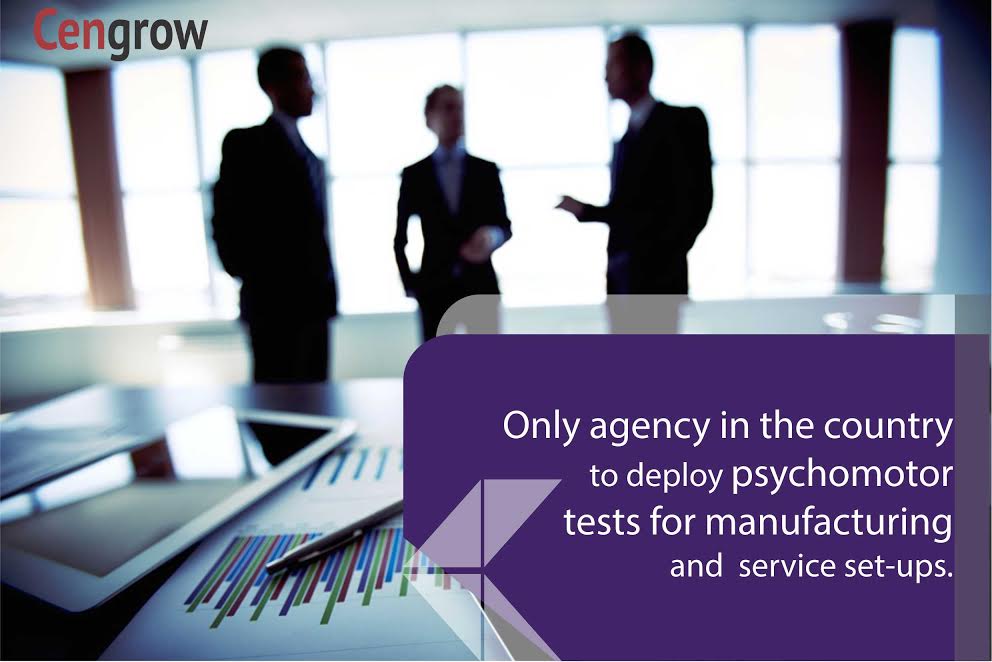
Psychomotor Testing: Efficient Operational performance

Psychomotor Testing is a unique yet an important element of the hiring process in companies. Covering a full range of job-specific aptitudes, cognitive ability and personality tests, this test offers a comprehensive solution to hire and manage the right employee and accurately predict performance metric for specific roles.

a5
Why is it Important?

Psychometric tests cover a mix of ability and aptitude tests that includes a specific questionnaire on competency mapping to help deliver a clear and concise insight into the candidate’s talent, attitude and attributes. It highlights the key performance areas of the employee and helps companies to understand the behaviour and psychic of an individual. Interviewers can get a first-hand insight on employee by assessing the logical reasoning abilities of an individual and how one responds to changing situations or challenges that sprout in a working environment.

Benefits of Psychomotor Testing

Conducting Psychomotor Testing not only benefits an organisation in assessing and hiring the right candidates but also helps in improving the organisations internal workforce.

Most of the Psychomotor Testing are prepared with multiple-choice questions and timed. Unlike other tests, these tests do not have a right or wrong answer but focuses on the candidates/employee’s personality and general outlook. Moreover, these tests can be conducted offline and can also be integrated and automated online, making them easy to use and convenient for all kinds of companies.

It is important for organisations today to focus on evaluating performance and growth potential of its employees and most of the companies are adapting and preparing psychometric tools including a questionnaire on competency mapping that helps employers introspect and enhance their workforce and gauge the right talent. Cengrow, a global consulting firm designs and conducts performance management tests along with a range of assessment solutions including psychometric testing, competency mapping and other tools that help businesses lead and perform better.

These kinds of questionnaires offer role clarity and make the selection process simpler and much more effective than the traditional hiring method of just interviewing the candidates.

Organisations following competency mapping have benefitted immensely by getting a chance to identify potential employees, analysing the person’s core strengths, key competencies and how one reflects in a demanding work atmosphere. Additionally, competency mapping provides an insight on a person’s work style and specific skills that may be suitable of the open or higher position in and within the organisation. By giving a fair insight of the employee, the employers can effectively map the right person to the specific job and help him perform better or move up with the roles fitting his personality.

In short, competency mapping helps identify qualifies individuals, assesses performance of the existing workforce and focuses on enhancing productivity of the organisations objectives and reach its overall objective for a successful growth.

It is time to select and develop your organisations human asset by choosing an experienced business consulting firm like Cengrow that offers tailor-made solutions like competency mapping assessments and psychomotor testing to help you hire the right talent. It is time to adapt new tools and methodologies that enhance your organisation’s goal setting, performance appraisals and employee’s career planning in a better more improved way.

Competency Assessment – Key to Better Hiring

One of the most challenging tasks for the human resources – HR team in any organisation is to search, find and choose the right talent. Competence at work is crucial for projects productivity and in the overall growth of an organisation. When it comes to recognizing employee competencies, most organisations fail to recognise and utilise their true talent and skills. This is the reason so many organisations today conduct competency assessments or ask employees to undertake a competency mapping questionnaire that help them effectively hire and manage their workforce.

a4

Competency Assessment – Placing Right People in The Right Jobs

Competency assessment is a process that has been designed to measure and assess an individuals or a group’s performance consistently in relation to the business requirements of the organisations they are enrolling or applying for. The process includes a competency mapping questionnaire that the employee answers and helps organisations understand and identify key attributes and skills that the person has in order to fulfil his job roles & responsibilities. In fact the employee too will be happy to be fit for the job he is assigned to and that shall help him build a positive relationship with co-workers, seniors and coordinated better internally.

Psychomotor testing not only helps gauge a person’s performance effectiveness but also his ability to process and follow instructions and react to situations succinctly.

Vital Requirement for All Organisations

Competency assessment is vital to all organisations big or small, new or old as it assists in hiring the right talent. It can also help organization in a variety of other tools and measures including a 360 degree feedback that helps in job promotions, internal assessments etc.

Every company needs to implement competency mapping assessment and make it an essential exercise. It will enhance the performance of each role and will help improve training and development procedures and in turn improve functional and technical competencies of the workforce.

The business environment is constantly changing and with a dynamic business it is imperative for the human resources to implement the right competency mapping and truly evolve talent management, development and overall employee appraisal format.

In recent times, global competition defines an organisation’s growth and business strategies need to be implemented for efficient workforce. Technology presents new solutions and with new tools and applications being launched constantly, customised assessment solutions including psychometric tests, competency mapping and other career-based approaches have enhanced human resource’s management and have proven positive in enhancing the organisations productivity and overall growth. So if your organisation is in need to match the right talent with the right jobs, get in touch with a business consulting firm like Cengrow, a respected and recognised international consulting firm that specializes in designing, preparing and conducting competency assessments, psychomotor tools, Critical Reasoning Test and psychometric testing for leadership and many other proven methodology and tolls for organisations and sectors located globally.

Competency Mapping: Importance for Employee Selection

we-give-you-success-stories-cengrow

Competency Mapping is a process that helps identify key competencies for a particular position in an organisation or for using it for training, recruitment, performance management and succession planning. It is a behavioural trait and not a skill or an ability that defines an individual’s competencies that make him meet the job demands within the parameters put by the organisation.

High in Demand

Competency Mapping is not a new concept, but in recent years it has been in high demand and many organizations use competency models as a basis for their performance management systems. Today, the organisations and businesses have understood its importance for employee selection as a process.

Encompassing professional, personal and technical competencies, competency mapping is highly flexible and can be customised as per the client’s needs. Moreover, it can even be built upon an already existing competency map of an organisation.

Benefits of Competency Mapping

The benefit of competency mapping is that it creates standards for employee training and development specifically tailored to your organizational needs.

It is a quick and efficient method that focussed and analyses how employees work and usually takes 1 or 2 days time period.

Creating a competency map helps to drills down to the skills, knowledge, abilities, and behaviours required for each unit of work. This approach makes the competency map a very useful and practical tool for organizations.

Another benefit is that it creates a comprehensive list of specific skills required to be performed on a job. This forms the basis of a competency assessment that focuses on how an employee performs at work in relation to the specified performance standards. In fact a competency mapping also provides ongoing employee performance coaching in lieu with the assessed employee’s acceptance. This not only benchmarks employee performance but also helps organisations target performance deficits and highlights skills that require additional trainings or specialised courses. Furthermore, it avoids the pitfalls of cumbersome documentation and complicated methods that often result in generic competency statements.

A competency model can be used for selection, placement, redeployment, performance management and evaluation, planning training & development, career role mapping and separation. Competency models are also useful as they not only communicate what is important to an organization but also provide a stable foundation for developing integrated human resource systems such as staffing, training, promotion, succession planning and performance management.

Should you be interested to use competency mapping, you should get assistance from experienced management and business consulting firm like Cengrow. With more than 30 years of expertise in management consulting globally, Cengrow provides end-to-end solutions for all your business challenges and adds value to your organisation’s performance, people and process. They help organizations identify key competencies and define associated critical behaviours that are linked to their strategic objectives and key success factors of their business.